A Driving Under the Influence charge in Illinois is never just one fine. It’s a criminal case, a separate license suspension fight with the Secretary of State, a set of mandatory alcohol education, and years of higher insurance rates, all stacked on top of each other.
If you were arrested in Rolling Meadows, Wheaton, Geneva, or anywhere in Cook, DuPage, Kane, or Lake County, here’s what that stack actually looks like, and how a DUI attorney comes into play.
What to Expect with a First-Time DUI
Most first-time DUI cases in Illinois end up costing somewhere between $10,000 and $20,000 once every category below is counted, and that’s before you factor in a raise in your auto insurance premium that can follow you for three to five years.
Here’s the rough breakdown for a standard first offense:
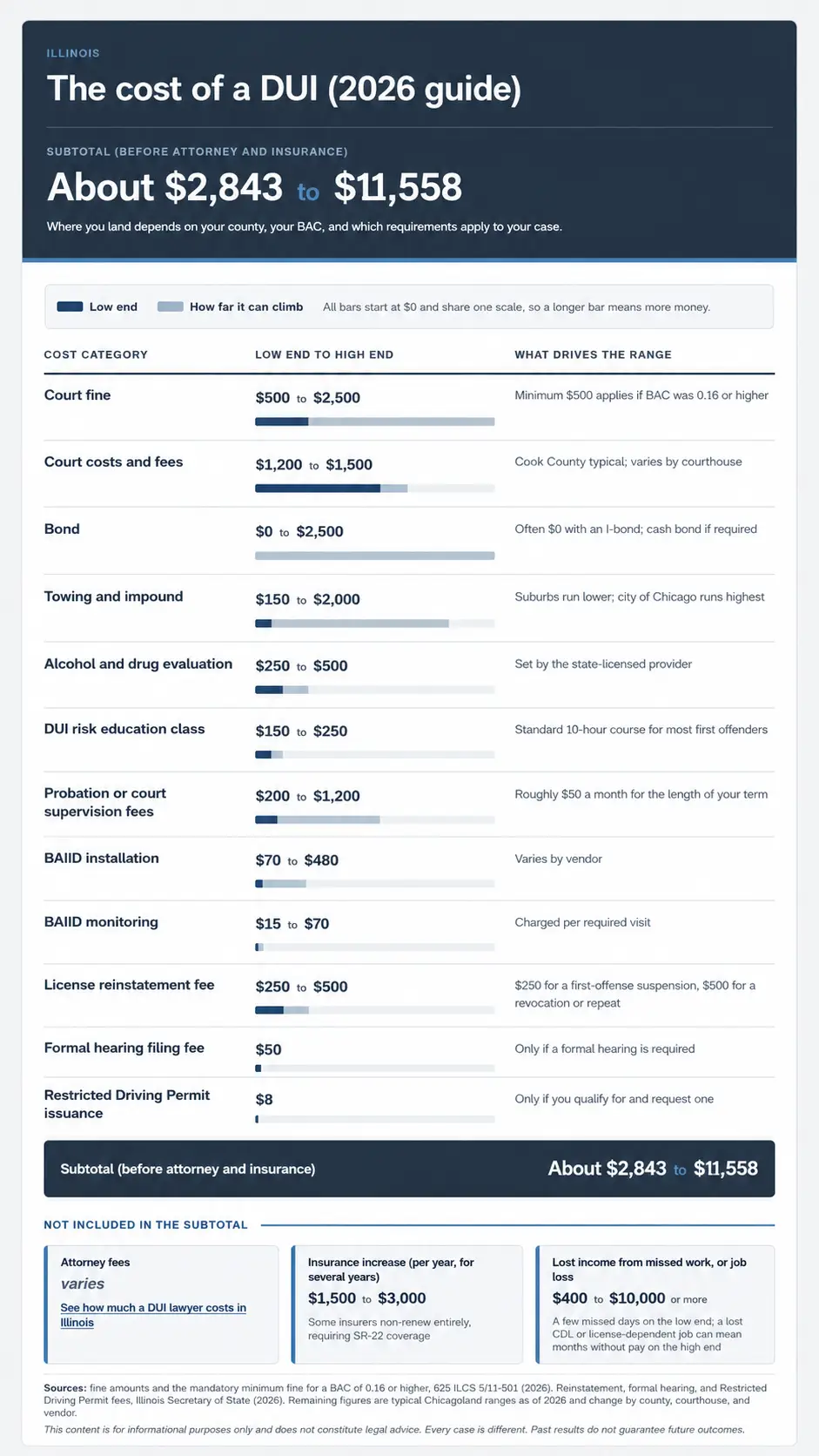
These are estimates built from Illinois’s own fee schedules and typical court costs. Your actual number depends on your county, your BAC, whether it’s a first offense, and how your case resolves.
How Much the Criminal Case Itself Costs
A first DUI in Illinois is a Class A misdemeanor under 625 ILCS 5/11-501. That carries a fine of up to $2,500 and up to 364 days in jail, though jail time on a standard first offense is rare. If your BAC was 0.16 or higher, the law adds a mandatory minimum $500 fine and 100 hours of community service on top of the standard penalties.
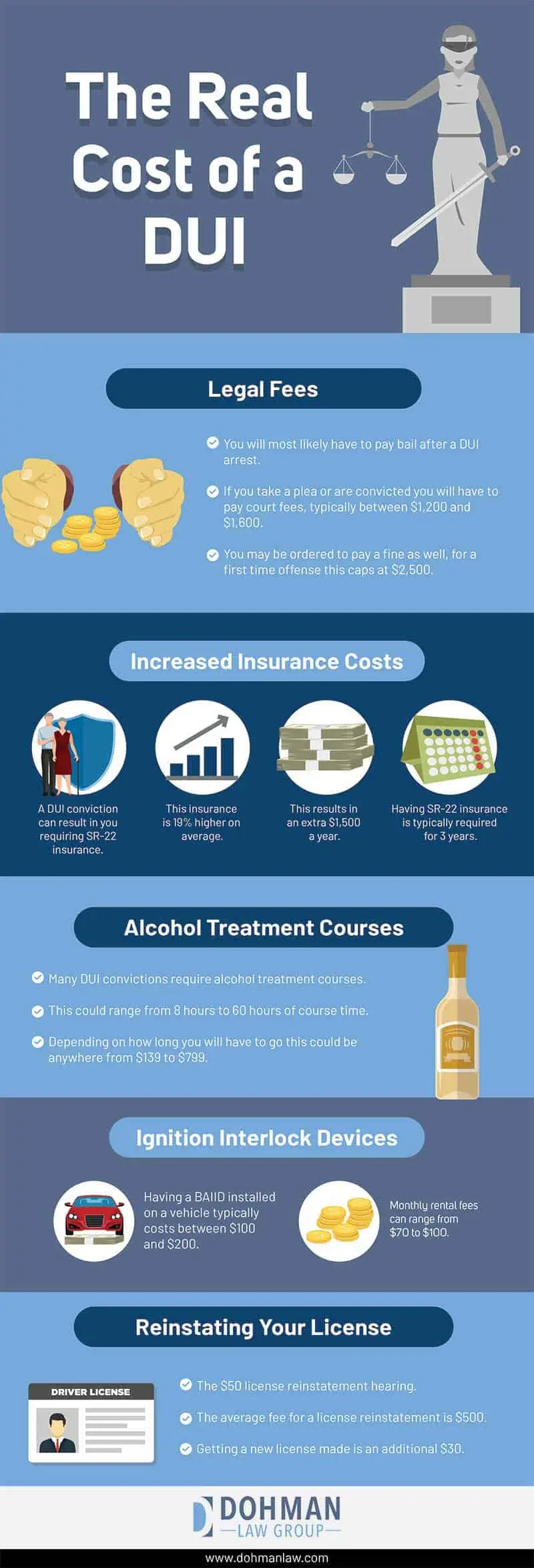
On top of the fine, courts charge separate court fees that aren’t part of the statutory fine. In Cook County, those typically run $1,200 to $1,500, though the exact number depends on the courthouse and the charges filed alongside the DUI, like speeding or an accident.
Most first-time DUI arrests in Illinois don’t end in a conviction. According to the Illinois Secretary of State’s DUI Fact Book, only about 22% of first-time offenders are convicted. Most receive court supervision instead, a sentencing option that keeps a conviction off your record if you complete its conditions. Repeat offenders don’t have that option, which is one reason a second DUI costs so much more than a first.
Did you know?
Dohman Law serves Waukegan, Lombard, Aurora, Elgin, DuPage County, and more.
The Secretary of State Bill Nobody Warns You About
Here’s what a lot of people miss: the criminal case and your driver’s license are handled by two completely separate systems, and both come with their own costs.
The moment you fail or refuse a chemical test, the Secretary of State imposes an automatic statutory summary suspension, regardless of what happens in court. For a first offender, that’s a 6-month suspension if you failed the test, or 12 months if you refused it. If you’re convicted, a separate post-conviction revocation follows, running at least one year.
Getting your license back after either one isn’t free:
- $250 to reinstate after a first-offense statutory summary suspension
- $500 to reinstate after a revocation or a repeat-offense suspension
- $50 filing fee if you need a formal hearing
- $8 to issue a Restricted Driving Permit, if you qualify for one
Illinois also requires a Breath Alcohol Ignition Interlock Device, or BAIID, before most drivers can get back on the road, even for a first offense. Installation runs $70 to $480 depending on the vendor, and monitoring visits run $15 to $70 each. If you install a BAIID and qualify for a Monitoring Device Driving Permit, you can often keep driving privileges during the suspension itself, which is worth knowing if losing your license would cost you your job.
The Unavoidable Fees the Court Adds On
Anyone convicted of, or placed on supervision for, a DUI in Illinois has to complete a DUI evaluation from a state-licensed provider. That evaluation runs $250 to $500 and decides what comes next.
First-time offenders typically take a 10-hour DUI Risk Education course costing $150-$250. If there’s a serious issue or repeat offense, longer treatment costing several hundred dollars and lasting weeks is required.
Missing classes or payments during probation or supervision can lead to court issues. Expect a $50 monthly supervision fee throughout your term.
 The Cost That Keeps Billing Even After the Case Closes
The number that surprises people most isn’t anything above. It’s what happens to their car insurance.
A DUI conviction increases insurance costs, raising premiums by $1,500-$3,000 annually. Some insurers won’t renew policies, forcing you into costly SR-22 coverage. Over 3-5 years, this expense often exceeds the initial fine.
Then there’s the record itself. Under Illinois law, a DUI conviction stays on your driving record for life. It can’t be expunged. Even court supervision, which avoids a conviction, generally still shows up on your driving abstract and can’t be sealed later. If your job requires a clean driving record, criminal record, a commercial license, or a professional license in a regulated field, that permanence is worth thinking about well before your court date.
Where the Number Jumps: Special Situations
Everything above describes a standard first offense. A few situations push the total significantly higher:
- A second offense carries a mandatory minimum of 5 days in jail or 240 hours of community service, on top of higher fines and a longer suspension. Court supervision usually isn’t available, which means a conviction and everything that comes with one.
- A third offense or higher in Illinois is charged as aggravated DUI, a felony, with prison exposure and fines that can reach $25,000.
- A Blood Alcohol Content of 0.16 or above adds a mandatory minimum fine and community service on any offense level.
- Commercial driver’s license holders face a DUI at a BAC of just 0.04, and a conviction can end a CDL and the career that depends on it, regardless of whether it’s a first offense.
If any of these apply to you, the breakdown above is a floor, not a ceiling. We’ve covered second offense and felony DUI penalties in more detail if that’s closer to your situation.

Total Cost Can Change from County to County
The statutes are the same everywhere in Illinois, but court costs, how aggressively a case is charged, and how a courthouse handles supervision requests can vary by county. A first-time DUI moving through the Rolling Meadows courthouse in Cook County doesn’t necessarily play out the same way as one in Wheaton (DuPage County) or Geneva (Kane County).
Local variations make generic national numbers ineffective for planning. This is why an attorney familiar with specific courthouses, not just Illinois law, is crucial.
What and Who Actually Keeps This Number From Growing
Most of the categories above are fixed once you know your offense level: the fine, the reinstatement fee, the BAIID cost. What isn’t fixed is how your case gets charged and resolved, and that’s where the total can move the most.
A local attorney can challenge weak evidence, scrutinize the stop or test process, and seek court supervision if eligible. This doesn’t guarantee a result; each case depends on its facts. It’s about managing your case, not just enduring it.
If you’re facing a DUI in Rolling Meadows, Wheaton, Geneva, or anywhere in Cook, DuPage, Kane, or Lake County, we’re available 24/7 for a free consultation. Call 847-616-9993, or reach the office nearest you.
FAQ
Court supervision avoids a criminal conviction if you complete its conditions, which is a real benefit since Illinois doesn’t allow DUI convictions to be expunged. That said, supervision generally still appears on your driving abstract and typically can’t be sealed later, so it isn’t the same as the case disappearing.
Even a straightforward first offense that resolves with court supervision typically involves a fine, court costs, an evaluation, a risk education class, and a reinstatement fee. Realistically, that floor is around $2,000 to $3,000 before attorney fees or any increase in your insurance premium.
Some insurers non-renew a policy after a DUI conviction, which usually means shifting to a high-risk policy that requires SR-22 coverage. Even insurers that keep you typically raise premiums by $1,500 to $3,000 a year for several years.
Significantly. A second DUI offense carries mandatory jail time or community service and usually isn’t eligible for supervision, so it comes with a conviction. A third offense and beyond is charged as felony aggravated DUI, with fines up to $25,000 and prison exposure.